.png)
How One Contractor Generated $300K+ Post-Storm
A sudden emergency—like a severe hailstorm, a burst pipe, or a fallen tree—leaves homeowners stressed, vulnerable, and asking one urgent question: Who can I trust to fix this right now?
For home service contractors, reaching these distressed homeowners digitally is harder than ever. Social media feeds are chaotic, search engine algorithms are fickle, and digital ad costs spike the moment a local crisis hits.
But while your competitors are fighting for expensive clicks online, a quieter, battle-tested channel is winning the neighborhood.
Direct mail remains one of the fastest, most trusted, and least crowded marketing channels for emergency home services. To prove it, we are diving into the story of Tony Lucero, owner of Altitude Roofing and Restoration, who turned a single 5,000-piece mailer into over $300,000 in revenue following a major storm.
Here is why direct mail wins in a crisis—and how you can apply these lessons to your own market.
The Unique Psychology of Emergency Home Services
Unlike routine home maintenance or aesthetic upgrades, emergency home services require immediate action. Homeowners aren't casually browsing or looking for the cheapest coupon; they are looking for reassurance, speed, and authority.
Furthermore, emergencies breed skepticism. When disaster strikes a neighborhood, fly-by-night operations and "storm-chasers" often flood the area, knocking on doors and making grand promises. Homeowners naturally put their guard up against digital pop-up ads and unverified text messages.
This is where the power of physicality comes in. A high-quality, physical piece of mail feels tangible, established, and local. It signals that your business is anchored in the community, giving stressed homeowners a sense of security when they need it most.
Why Direct Mail is Built for Emergency Scenarios
Direct mail isn't an "old-school" tactic; it’s a high-precision tool. In a crisis scenario, it offers several massive advantages over digital marketing:
- Hyper-Localized Targeting: Using data tools like Every Door Direct Mail® (EDDM®), contractors can target the exact streets, subdivisions, or zip codes affected by a specific emergency event—without wasting budget on unaffected areas.
- Zero Digital Noise: While a homeowner's smartphone is buzzing with overwhelming news alerts and fragmented social feeds, the mailbox offers a calm, low-competition environment.
- An Extended Shelf-Life: A digital ad disappears the moment a user scrolls past. A physical postcard sits on the kitchen counter, gets placed on a desk, or is stuck to the refrigerator. It becomes a persistent reminder of your services as the homeowner navigates insurance claims or chats with neighbors.
- High Ticket Value vs. Low Cost: Emergency home services—like a full roof replacement—often come with substantial project values. Because the return on investment (ROI) is so high, a contractor doesn't need thousands of responses. Just one or two closed jobs can completely cover the cost of the campaign.
Case Study: How Altitude Roofing Turned Mailboxes into $300K+
Tony Lucero has helped homeowners across Colorado and Wyoming recover from severe weather for more than 20 years. He knows firsthand that when disaster strikes, the contractors who win are the ones homeowners already recognize.
Following a severe storm system that dropped baseball-sized hail across Northern Colorado, Lucero needed to reach affected homeowners quickly and effectively.
Altitude Roofing's Campaign At-A-Glance:
------------------------------------------
Campaign Type: Targeted EDDM® Postcard
Distribution: 5,000 Pieces
The Offer: Free Storm Inspection & Insurance Help
Jobs Closed: 15 Roof Replacements
Total Revenue: $315,000 - $460,000+
The offer on the postcard was straightforward and frictionless: a free storm damage inspection and expert assistance navigating the complex insurance claims process.
The campaign yielded 15 roof replacement projects. With average residential roof replacements ranging from $21,000 to $30,000 or more, that single mail drop produced an estimated $315,000 to $460,000+ in revenue.
As Tony’s campaign proves, direct mail doesn't need to generate massive response rates to be wildly successful. A relatively small number of highly qualified prospects can produce outsized business results.
Deconstructing the Winning Mailpiece
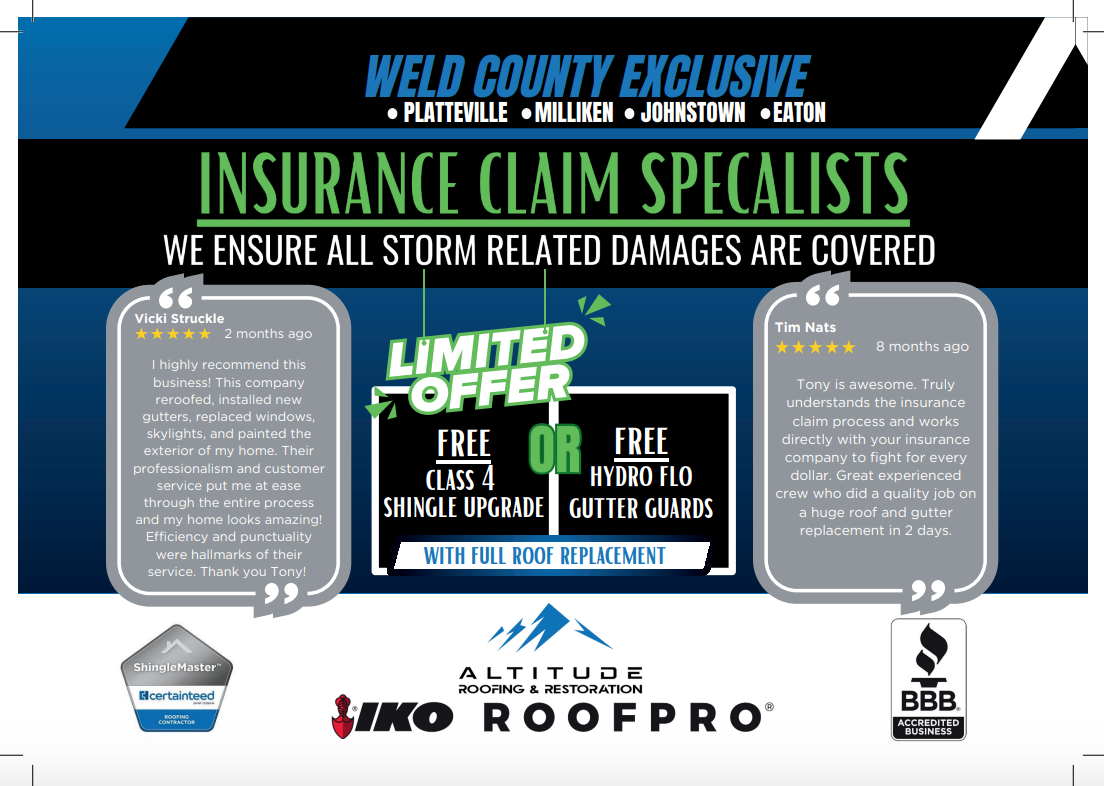
So, what does a winning emergency response mailer actually look like? Altitude Roofing’s postcard succeeds because it doesn’t look like generic junk mail—it looks like an official community update.
The front immediately hooks stressed homeowners by calling out specific local towns, showcasing real reviews from neighbors who praised Tony for fighting the insurance companies, and displaying prominent industry trust badges.
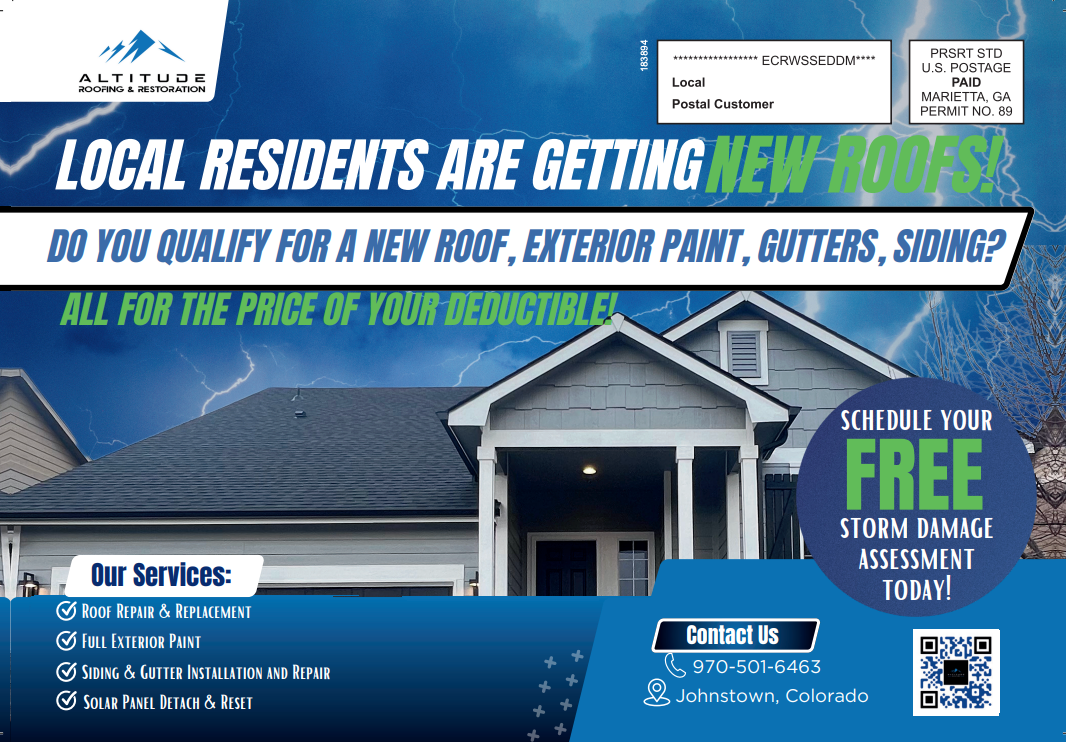
Flip the card over, and it seals the deal by addressing cost anxiety head-on. By offering a free storm assessment right next to a bold promise—all for the price of your deductible —the design transforms a advertisement into a trusted local solution.
The Blueprint: 3 Principles for Winning the Neighborhood
To duplicate this success in your own home services business, follow the three core principles used by top-performing contractors:
1. Perfect Your Timing
In an emergency, speed is equity. You must move quickly post-event to get your message into the hands of affected homeowners before they commit to a competitor. Have your mail designs and targeting parameters ready before the crisis happens so you can pull the trigger instantly.
2. Choose Clarity Over Cleverness
When people are stressed, they don't want to decipher a clever riddle or a dense wall of text. Your emergency mail piece should feature a bold headline, a clear local identifier, and a friction-free call to action (e.g., "Free Emergency Inspection — Call Today").
3. Build an Omnichannel Ecosystem
Direct mail shouldn't exist in a vacuum. A homeowner who receives your postcard today will likely look you up online tomorrow. Ensure your website, Google Business Profile, and social media channels match the professional, trustworthy image of your mailer. Tony Lucero’s team successfully backed their mail campaign with neighborhood-targeted digital ads and email outreach to dominate local visibility.
Final Thoughts
The home services industry has changed dramatically, but the fundamentals of human trust remain exactly the same. Homeowners want to hire established, professional contractors who feel local and reliable.
Direct mail continues to succeed because it respects those fundamentals. It isn't about chasing temporary clicks; it’s about claiming your space in the neighborhood and building trust before your competitors even have a chance to log into their ad accounts.